

Blog
Voice-Controlled Drones: How the Motorola R7 Becomes a UAV Command Radio


Walk onto any serious work site today and you will see two screens in play: the radio clipped to the commander’s chest, and the drone tablet somebody has to babysit. Inspection crews, power-line patrols, mining and border teams have spent years running these two tools in parallel — one carries voices, the other carries flight — without a clean way to make them talk to each other.
That split is starting to close. A quietly growing line of systems engineering around Motorola’s MOTOTRBO platform has produced something that sounds futuristic until you see how plainly it is built: the commander presses PTT and says “Drone One, climb to fifty meters” — and the aircraft climbs.

The R7 Was Already the Right End of the Network
Nobody picked the MOTOTRBO R7 for this role by accident. On paper it is a digital DMR portable; in practice, much of its engineering budget went into the parts that matter when a machine has to listen. Two microphones form an adaptive array that strips site noise before the voice ever reaches the radio chain. Acoustic feedback suppression keeps five radios from howling when the crew crowds into one cab. Intelligent Audio watches the noise floor and drives the speaker as high as roughly 107 phons — about four times the loudness of a normal conversation, which is the difference between catching an instruction over a generator and missing it.
The hardware wraps all of that in IP68 and IP66 sealing, a MIL-STD-810 test history from revision C through H, and an intrinsically safe variant for hazardous sites — plus a 2.4-inch touchscreen, Bluetooth 5.2, Wi-Fi and up to 28 hours of IMPRES battery life. It is a radio built for places that are loud, dirty and mission-critical, which is exactly where drones have started to work.
Five Steps From PTT to Propellers
The working architecture is refreshingly honest about what a radio should be. The R7 is not being turned into a remote controller. It stays what it already is — a dependable voice pipe — and a control center does the thinking:
First, the commander presses PTT and speaks; the voice rides the DMR air interface to every radio in the talkgroup. Second, a radio at the control center demodulates the call and hands the audio out through its rear accessory connector. Third, a voice control gateway runs speech recognition, parses intent and applies safety arbitration — turning “Drone One, climb to fifty meters” into a structured object: unit, action, parameters, confidence score. Fourth, the gateway translates that object into MAVLink, the de facto standard protocol that PX4 and ArduPilot flight controllers already speak — altitude changes, waypoints, return-to-launch, gimbal and camera commands are all off the shelf. Fifth, the drone answers the way it came in: telemetry converted to synthesized speech and pushed back through the radio network to every ear on site.

The only genuinely new piece of engineering is the box in the middle. Everything around it — DMR, MAVLink, the flight controllers — is mature, documented and already flying.

No Word Reaches a Motor Without Permission
The principle that makes this safe enough to field: recognized speech never connects to the flight controller directly. Every utterance becomes a structured object first, and a safety engine rules on it by risk tier before anything moves.
Read-only questions — battery state, position, gimbal angle — execute immediately. Anything that changes the flight path, altitude or destination triggers a readback: the gateway repeats the parsed command and waits for the crew member to say it back. Takeoff, landing and return-to-home demand a two-step verbal handshake — “Confirm: Drone One takeoff, fifty meters. Say confirm to execute.” — before the command unlocks. And some things never unlock: disabling geo-fencing or obstacle avoidance by voice is permanently forbidden in the design.
Around that core sit three more layers. The drones listen only inside a dedicated MOTOTRBO talkgroup, so a routine “go take a look east” never moves an aircraft. Every call carries the sender’s radio ID, which the gateway checks against a permission list — a commander can launch and recall, an inspector can ask for status and nothing else. And because the R7 carries GNSS, “Drone One, come to me” becomes a real command: the gateway reads the commander’s live coordinates and turns them into the MAVLink target.

Why Audio Quality Is the Whole Ballgame
Here is the part that rarely makes the brochure but decides whether any of this works. DMR digitizes voice through the AMBE+2 vocoder, which compresses speech to roughly 2,450 bits per second — about 3,600 with forward error correction. That codec is tuned for human ears, and human ears are forgiving. Speech recognizers are not: they feed on exactly the details a low-rate vocoder shaves off.
Worse, the codec punishes noisy input disproportionately. Its bit budget is fixed, so when wind and machinery crowd into the frame, bits get spent encoding the noise and speech quality collapses faster than the noise grew. By the time a call reaches the gateway, the damage is done — no amount of server-side cleanup brings the lost detail back.

That is why the decisive noise removal has to happen inside the radio, before the vocoder. Every decibel of front-end signal-to-noise the R7’s dual-mic array adds gets multiplied by the codec on the other side. The return link leans on the same physics: Intelligent Audio and the 107-phon output ceiling are what let “Drone One at point A, eighty meters, battery seventy-two percent” cut through a pump house, and feedback suppression is what keeps the control-center radio from howling while it talks and listens at the same time.

PTT Turns Out to Be the Perfect Button
Two classic headaches of voice interfaces simply disappear here. When does the system start listening? The PTT button is the answer — press to start, release to stop, no wake words, no false triggers. And nothing gets stepped on mid-sentence, because only one radio talks at a time anyway. The industry joke writes itself: PTT no longer stands for push to talk, it stands for push to command.
What Fleet Operators Should Take From This
The deeper value is not the party trick of talking to a drone. It is that the command input already sits in every crew member’s hand — charged, rugged, carried on every shift. No tablets in the rain, no second screen bolted into the cab, no new device to train on. A radio network the site already trusts quietly takes on a second job as the drone’s control channel.
Start With the Radio
To be clear about where the line sits: the gateway itself is a systems-integration project, not a box you order from a catalog. But its entire job is making your voice audible to a flight controller — and the radio you put in front of that gateway is the part you can get right today. Clean voice into a DMR network is the one input no amount of software can recover later. If drone inspection work is on your roadmap, these are the three MOTOTRBO-class radios from our shelf worth shortlisting:

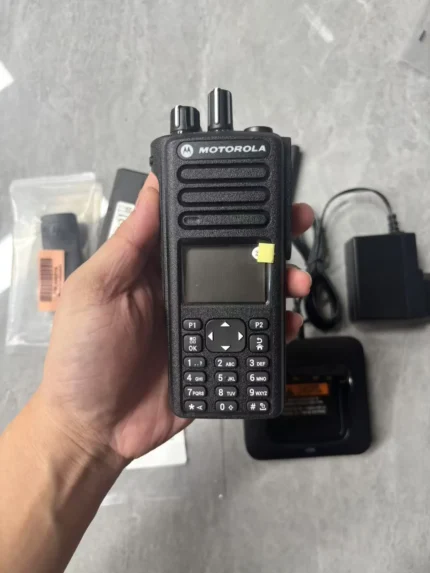

The R7ex is the intrinsically safe R7 variant — the exact model class this article is about, for sites that run hazardous divisions. The DP4800 covers dispatch-heavy fleets that want MOTOTRBO audio on a working budget, and the DM4600e is the natural control-center radio: it is the unit that would sit in front of the voice gateway, feeding it clean audio call after call.
Related reading: we tracked how the Kymeta Osprey u8 keeps multi-orbit satellite connectivity on the move, and what Xiaomi’s first in-vehicle 4G PoC radio changes for fleets.
Frequently Asked Questions
Can a regular two-way radio control a drone?
Not on its own. The radio’s job is to deliver clean voice to a control center, where a voice gateway handles recognition, safety arbitration and MAVLink translation. What separates a professional DMR radio like the Motorola R7 from budget units is noise removal before encoding – without it, recognition rates collapse in loud sites.
How reliable is voice recognition over a DMR network?
Usable in the field because the command set is deliberately narrow and every risky command is confirmed by readback or a two-step handshake. Accuracy depends almost entirely on how much noise was stripped before the AMBE+2 vocoder compressed the call – which is why the R7’s dual-microphone array matters more than any server-side cleanup.
Do voice-commanded drones need special approval?
The control input does not change aviation rules: the flight must comply with local drone regulations and the radio link must use licensed frequencies. Several countries also require specific approvals for beyond-visual-line-of-sight operations. Check your local aviation authority before deploying any voice-control workflow.
Technical parameters for the Motorola R7 and the MOTOTRBO platform follow the manufacturer’s public specifications. Voice control of unmanned aircraft is subject to aviation and radio-licensing rules in most countries — verify local regulations and required approvals before deploying any drone command system.